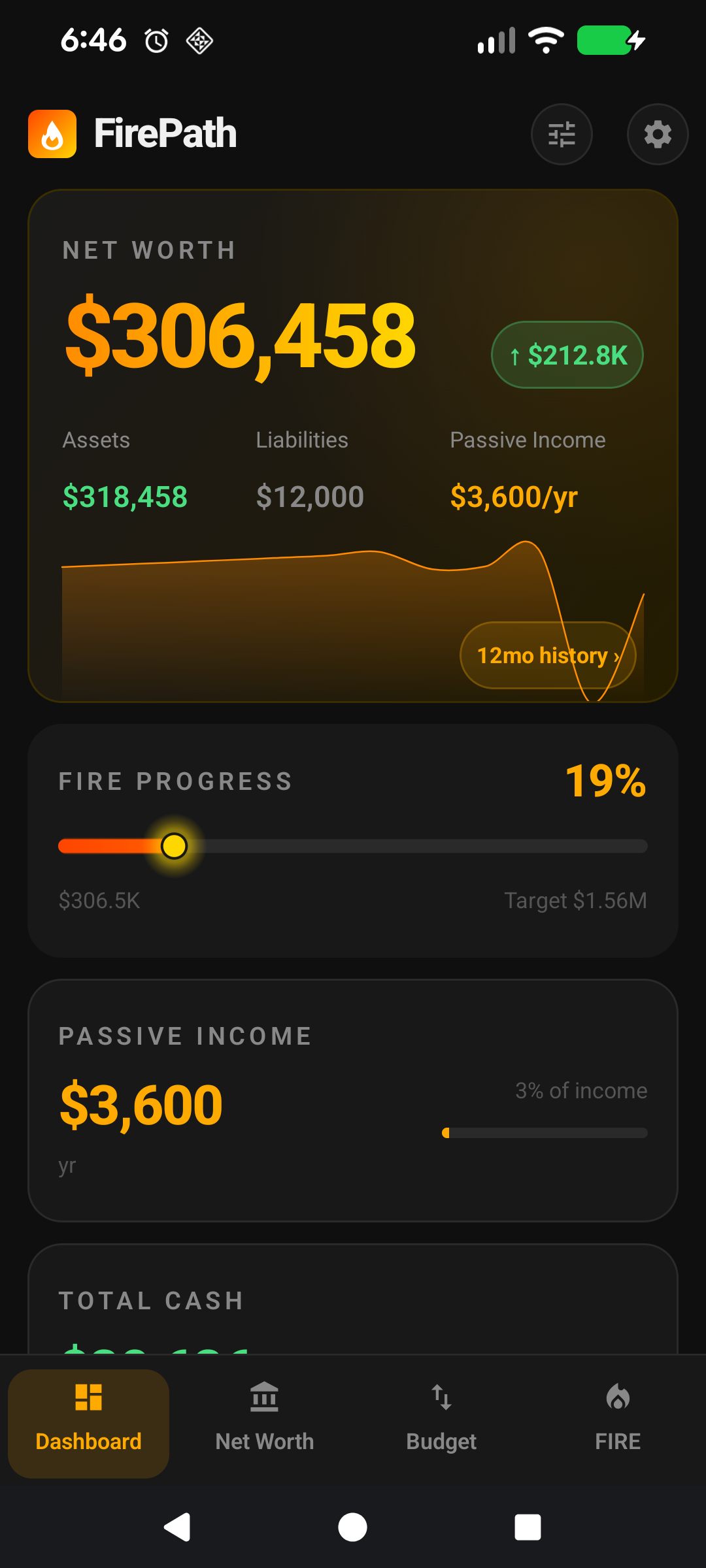
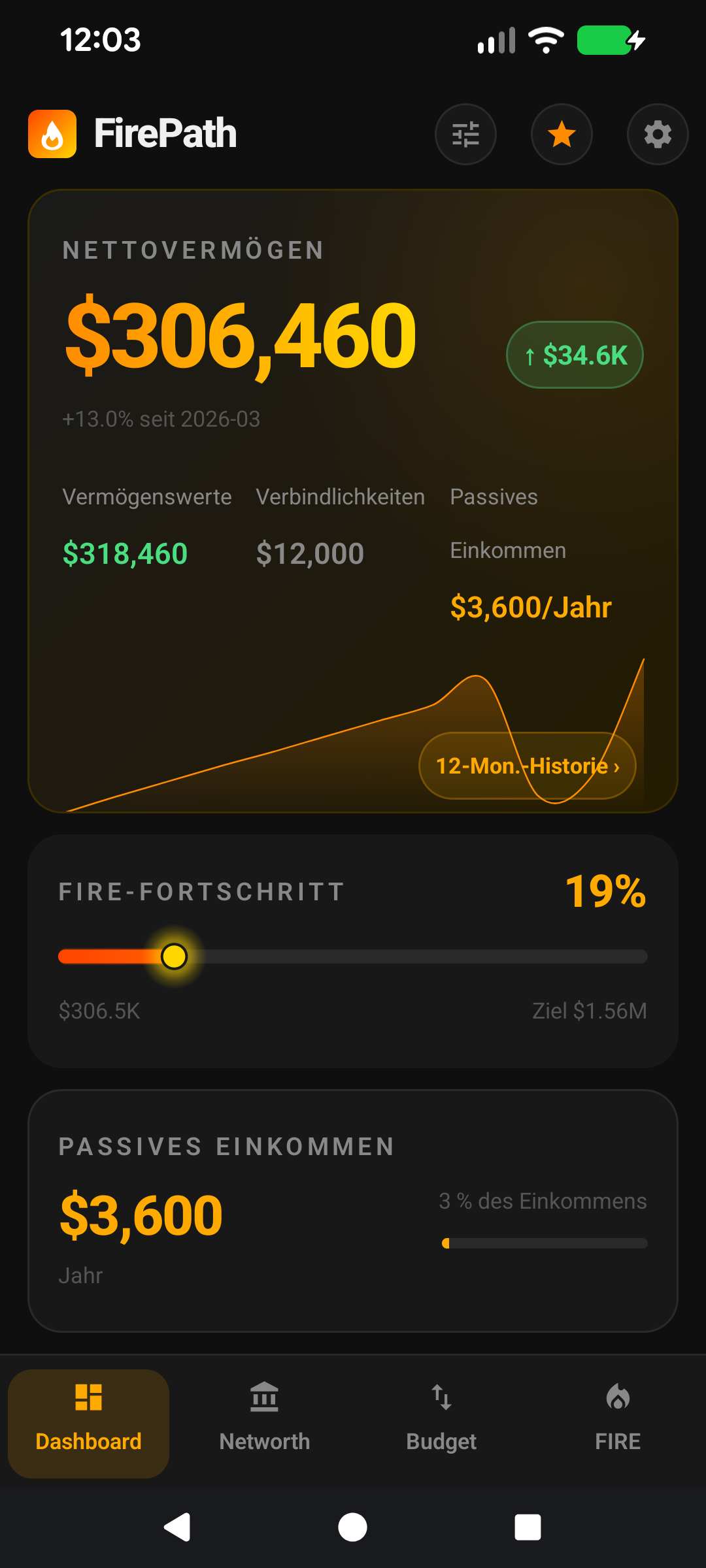
Income and Expenses: categorise, normalise periods (weekly / fortnightly / monthly / yearly), flag passive income, opt into Lean FIRE, drag-sort categories in Settings.Einnahmen und Ausgaben: kategorisieren, Zeiträume normalisieren (wöchentlich / zweiwöchentlich / monatlich / jährlich), passives Einkommen markieren, in Lean FIRE einbeziehen, Kategorien per Drag in den Einstellungen sortieren.
Quick start
The Income & Expenses screen lets you add recurring money-in and money-out items. Each item has an amount, a period, a category, and a few optional flags.
Amount + period — enter what you earn/spend and how often (weekly, fortnightly, monthly, yearly). FirePath normalises everything to monthly for the Dashboard summary.
Category — group items so the Dashboard can show breakdowns (Salary, Rent, Groceries, etc.).
Passive flag (income only) — ticks this one into the Dashboard's Passive Income card.
Include in Lean FIRE (expense only, premium) — controls whether this expense is counted in your Lean FIRE target.
The rest of this guide is for users who want to tune the screen. If you're happy with the defaults, you can stop here — everything below is optional customisation.
Going deeper
Period normalisation
① Period chip (weekly / fortnightly / monthly / yearly). ② Normalised annual total drives FIRE and summary.
FirePath supports weekly, fortnightly, monthly, and yearly periods. Under the hood everything is normalised to a monthly figure for the Dashboard and the FIRE calculator. A weekly expense of $200 becomes $866.67/month (52 weeks ÷ 12); a yearly tax bill of $12,000 becomes $1,000/month. You enter the figure in the period that's natural for you; the app does the conversion.
Passive vs active income
① Passive toggle — feeds the Dashboard Passive Income card.
Toggle Passive Income on any income item that arrives without active work: rental net income, dividends, distributions, royalties, interest. Active income (salary, freelance fees, side-hustle) stays toggled off. The Dashboard's Passive card sums the ticked ones; the difference between total and passive is your active income.
This split matters because FIRE is ultimately about replacing active income with passive income. Watching the ratio move over time is one of the most motivating views in the app.
Include in Lean FIRE (expenses)
① Include-in-Lean-FIRE toggle. ② On = essential. Off = would be cut in Lean retirement.
Lean FIRE is the version where you retire on the absolute minimum — rent/mortgage, food, insurance, utilities, basic transport. Everything else (dining out, travel, hobbies, luxury subscriptions) is excluded.
Each expense has an Include in Lean FIRE toggle. On by default (every expense counts in your current spend); turn off the ones you'd cut in a Lean scenario. The FIRE calculator's Lean variant uses the sum of the included expenses to compute the Lean target.
Category personalisation
Settings → App Lists → Income Categories / Expense Categories lets you shape the category list to your life. The built-in categories can be hidden (to stop them appearing on the Add screen) and reordered (so your most-used appear first), but not renamed — the built-ins are fixed. If you want a name that doesn't ship with the app, add a custom category; your own categories are fully renameable and deletable. Renaming a custom category cascades automatically: every income/expense row referencing the old name gets updated.
Make it yours — Settings that affect this screen
Income Categories — Settings → App Lists. Reorder and hide the built-in categories; add your own custom ones (which you can then rename or delete freely).
Expense Categories — same pattern.
Default Annual / Monthly view — Settings → Display → Default Annual Summary. Controls whether Income & Expenses open in monthly view (off) or annual view (on) by default. The period on each individual item is independent of this — this just picks which total the screen shows at the top.
Schnellstart
Der Bildschirm Einnahmen & Ausgaben lässt Sie wiederkehrende Geld-Ein- und Geld-Aus-Einträge hinzufügen. Jeder Eintrag hat einen Betrag, einen Zeitraum, eine Kategorie und einige optionale Markierungen.
Betrag + Zeitraum — geben Sie ein, was Sie verdienen/ausgeben und wie oft (wöchentlich, zweiwöchentlich, monatlich, jährlich). FirePath normalisiert alles auf Monatswerte für die Dashboard-Zusammenfassung.
Kategorie — gruppiert Einträge, damit das Dashboard Aufschlüsselungen zeigen kann (Gehalt, Miete, Lebensmittel usw.).
Passiv-Markierung (nur Einnahmen) — nimmt den Eintrag in die Passives-Einkommen-Karte des Dashboards auf.
In Lean FIRE einbeziehen (nur Ausgaben, Premium) — steuert, ob diese Ausgabe in Ihr Lean-FIRE-Ziel einfließt.
Der Rest dieser Anleitung ist für Nutzer, die den Bildschirm anpassen möchten. Wenn Sie mit den Standardeinstellungen zufrieden sind, können Sie hier aufhören — alles unten ist optionale Anpassung.
Tiefer eintauchen
Zeitraum-Normalisierung
① Zeitraum-Chip (wöchentlich / zweiwöchentlich / monatlich / jährlich). ② Normalisierte Jahressumme treibt FIRE und die Zusammenfassung an.
FirePath unterstützt wöchentliche, zweiwöchentliche, monatliche und jährliche Zeiträume. Intern wird alles auf eine Monatszahl für das Dashboard und den FIRE-Rechner normalisiert. Eine wöchentliche Ausgabe von 200 $ wird zu 866,67 $/Monat (52 Wochen ÷ 12); eine jährliche Steuerrechnung von 12.000 $ wird zu 1.000 $/Monat. Sie geben die Zahl in dem Zeitraum ein, der für Sie natürlich ist; die App erledigt die Umrechnung.
Passives vs. aktives Einkommen
① Passiv-Umschalter — speist die Passives-Einkommen-Karte des Dashboards.
Aktivieren Sie Passives Einkommen bei jeder Einnahme, die ohne aktive Arbeit eintrifft: Netto-Mieteinnahmen, Dividenden, Ausschüttungen, Tantiemen, Zinsen. Aktives Einkommen (Gehalt, Freelancer-Honorare, Nebenverdienst) bleibt deaktiviert. Die Passiv-Karte des Dashboards summiert die markierten Einträge; die Differenz zwischen Gesamtwert und Passiv ist Ihr aktives Einkommen.
Diese Aufteilung ist wichtig, weil es bei FIRE letztlich darum geht, aktives Einkommen durch passives Einkommen zu ersetzen. Das Verhältnis im Zeitverlauf zu beobachten ist eine der motivierendsten Ansichten in der App.
In Lean FIRE einbeziehen (Ausgaben)
① Umschalter "In Lean FIRE einbeziehen". ② An = essenziell. Aus = würde im Lean-Ruhestand gestrichen.
Lean FIRE ist die Version, bei der Sie mit dem absoluten Minimum in Rente gehen — Miete/Hypothek, Essen, Versicherung, Nebenkosten, grundlegender Transport. Alles andere (Essen gehen, Reisen, Hobbys, Luxus-Abonnements) ist ausgeschlossen.
Jede Ausgabe hat einen Umschalter In Lean FIRE einbeziehen. Standardmäßig an (jede Ausgabe zählt in Ihren aktuellen Ausgaben); schalten Sie die aus, die Sie in einem Lean-Szenario streichen würden. Die Lean-Variante des FIRE-Rechners verwendet die Summe der einbezogenen Ausgaben, um das Lean-Ziel zu berechnen.
Kategorie-Personalisierung
Einstellungen → App-Listen → Einnahmenkategorien / Ausgabenkategorien lässt Sie die Kategorienliste an Ihr Leben anpassen. Die integrierten Kategorien können ausgeblendet werden (damit sie nicht mehr im Hinzufügen-Bildschirm erscheinen) und neu geordnet werden (damit die am häufigsten genutzten zuerst erscheinen), aber nicht umbenannt werden — die integrierten sind fest. Wenn Sie einen Namen möchten, der nicht mit der App mitgeliefert wird, fügen Sie eine benutzerdefinierte Kategorie hinzu; Ihre eigenen Kategorien sind vollständig umbenennbar und löschbar. Das Umbenennen einer benutzerdefinierten Kategorie kaskadiert automatisch: Jede Einnahmen-/Ausgabenzeile, die den alten Namen referenziert, wird aktualisiert.
Machen Sie es zu Ihrem — Einstellungen, die diesen Bildschirm beeinflussen
Einnahmenkategorien — Einstellungen → App-Listen. Ordnen Sie die integrierten Kategorien neu an und blenden Sie sie aus; fügen Sie eigene benutzerdefinierte hinzu (die Sie dann frei umbenennen oder löschen können).
Ausgabenkategorien — gleiches Muster.
Standard-Jahres-/Monatsansicht — Einstellungen → Anzeige → Standard-Jahreszusammenfassung. Steuert, ob Einnahmen & Ausgaben standardmäßig in der Monatsansicht (aus) oder Jahresansicht (an) geöffnet werden. Der Zeitraum jedes einzelnen Eintrags ist davon unabhängig — dies wählt lediglich aus, welche Summe der Bildschirm oben anzeigt.